Annenberg Media Streaming Video

The Annenberg Media website at learner.org is a resource that offers on-demand streaming video for “schools, colleges, libraries, public broadcasting stations, public access channels, and other community agencies”.

These are top-notch programs, several which I recognize as having been used in college-level learning. I stumbled upon this site while attempting to locate a replacement copy of one of the videos offered on the site.  They do require registration (free) in order to view the video streams.

Subject areas include:

Two additional subject area not listed on the site’s menu are:

I am not sure why these aren’t listed, but here they are in case you find them helpful.  Chalk this up to my always being curious about how web menus are set up (thanks RFS!)

The quality of the video stream is as good as any I have encountered.  The only suggestion I have to the viewer is if you are using Firefox, you should install the MediaPlayerConnect add-on.  You will find this to be a great addition to the browser and saves you from all the WMP (Windows Media Player) plugin mess.
Posted in Education, History, Language, Libraries, Online Services, Politics, Science, Video, Web Design | Tagged , , , , , | Comments Off on Annenberg Media Streaming Video

Embeddable Google Books

Google Books can now be embedded into a web page in a similar way that a YouTube video is able to be embedded.

Besides the “nifty cool” aspect of this, I can see one element of this that should make anyone involved with library web pages interested:   what a wonderous add-on to an OPAC!  No longer would we be limited to a link to the book in Google, but our users can potentially browse through a book during their search!  Examples here and here.

According to the Embedded Viewer API Developers Guide, identifiers for the books can be ISBN, OCLC, LCCN, and Book Search Volume numbers, or the Google Book Search URL for one-off uses.

Here is an example for a particular item being presented in WordPress. Do a search for “Wilbur Wright” to see why I chose it:

via LISNews and Technology Bites for WP solution

Posted in Blogs, Books, Google, ILS, Library 2.0, Online Services, Web Design | Tagged , , , , , | Comments Off on Embeddable Google Books

Book Covers and Copyright

I missed this last month, but a post on the LibraryLaw Blog suggests that book jackets may be protected under a clause in the copyright law aimed for advertisements and commentaries.

found via LISNews

Posted in Books, Copyright, ILS, Libraries, Web Design | Tagged , | Comments Off on Book Covers and Copyright

Footnote

Footnote is an interesting social network:  it contains entries and social linking for dead people.

The concept seems morbid at first thought; however, it does provide a structured place to remember the dead, as well as provide links to others they were connected with.

Areas of the site worth noting are the Pearl Harbor Muster Rolls and the Vietnam Veterans Memorial.  There are also a variety of Revolutionary and Civil War lists.

To gain an appreciation of the social aspect of this site, check out the Recent Connections page.

Keep this site in mind for the potential geneological information.

found via TechCrunch

Posted in Death, History, Online Services | Tagged , , , , | Comments Off on Footnote

Librarians, Sarah Palin, and Fact Checking (oh my!)

Jessamyn has the best overview of the Sarah Palin / Librarian debate that I have seen so far.  The key to this, and to any other emotionally charged story, is to check your facts, and remember that everyone gets it wrong sometimes (so don’t be so sure about something even if you are sure).

Unrelated, but soberingly relevant, is the United Airlines “bankruptcy” story from a couple of days ago.  The source seemed reliable, but the information was old.  Again, some basic fact checking in the early stages of this would have saved a whole lot of grief.

Update:  This New York Times article has a great overview of the UAL story… (thanks LISNews )

Posted in Libraries, News, Politics | Tagged , , , , , , | Comments Off on Librarians, Sarah Palin, and Fact Checking (oh my!)

Library Blogs

Walt Crawford (“The Library Voice of the Radical Middle”) has created a list of nearly 600 library-related blogs.  It is interesting to scan the list and marvel at how many are unknown to me.  I suspect that I could spend hours simply browsing through them…

Libology is in there, btw (kudos for being current!).

thanks to LISNews

Posted in Blogs, Libraries, Library 2.0 | Tagged , , | Comments Off on Library Blogs

Harry Potter and the Unfair Use Lexicon

TeleRead has an excellent post dissecting the recent ruling against the author of the Harry Potter Lexicon.  It examines the Fair Use aspects of copyright as they apply to this particular case.

via LISNews

Posted in Books, Copyright, News, Publishing | Tagged , , , , , | Comments Off on Harry Potter and the Unfair Use Lexicon

Kete

Kete is billed as a combination of a digital archive, a content management system, and collaboration tools meant to allow the storage, control, and access of digital content.

Developed as an outgrowth of the Koha project, Kete has a pedigree worth checking out!

found via Catalogablog

Posted in Libraries, Library 2.0, Open Source, Software | Tagged , , , | Comments Off on Kete

Google Chrome

Exciting news in the browser wars:  Google is releasing has released a beta version of a web browser that it is calling Chrome.

Why does this matter?  The open-source browser will feature:

  1. Every tab running in isolation from the other tabs – if something goes kablooey, you only lose that one particular tab.
  2. Streamlined code designed for efficient running of online software, which translates into faster speeds and greater stability.
  3. A new Javascript engine designed with future web applications in mind (and optimized versions of Google Apps, I bet).

Even if Chrome doesn’t become a contender (and you won’t catch me making that bet) these and other features will certainly set the stage for advancements in other web browsers.

Google has released a 40 page comic book (web version) (Pdf version) detailing their reasons for creating Chrome and highlighting its features.

Why should this excite libraries?  Just remember that the most exciting integrated library system out there, Evergreen, uses the XPCOM framework from the Mozilla project, and Chrome can likely be used in similar ways.

Here is a screen capture of Chrome’s logo (which reminds me a bit of the alien camera thingy in the 1953 version of War of the Worlds).

thanks to CNet News for reporting the leak…

Posted in Google, ILS, News, Open Source, Software, Web Design | Tagged , , , , , , , | Comments Off on Google Chrome

SOPAC 2.0 @ Darien Library

After much anticipation, version 2.0 of the Social Opac (SOPAC) went live this morning at the Darien Library in Connecticut.

It looks very good… excellent, in fact.  I am already looking forward to playing with this version of the software.  What I really like at first glance:

  • It was created with everyone in mind:  in theory can be coupled with any ILS for both the catalog and patron information.
  • It is designed to allow sharing of reviews and other public content between libraries, thereby creating a larger social “pool”.
  • The design is clean and looks to be well laid out.

The only problematic aspect I see initially is that it fails XHTML validation in a fairly dramatic way:  the doctype is listed as XHTML 1.0 Strict, but appears to have over 50 problems with the home page alone (over 200 for an OPAC search result page).  By just looking at the numbers, each type of page comes dramatically closer to validating as HTML 4.01 Strict (19 errors and 67 errors respectively) which seems odd to me.

Compromises in validation often have to be accepted for results pages, but I see no reason for not having a standards-compliant entry page.  I suspect that this could be a great “clean up” project once the dust has settled from the upgrade.

Overall, this is a great accomplishment, and a great piece of software.  This is certain to grab a lot of well-deserved attention, and will hopefully inspire all ILS and OPAC creators to improve their products.

thanks to Jessamyn for her post

Posted in ILS, Libraries, Library 2.0, News, OPAC, Open Source, Software, Web Design | Tagged , , , , , | Comments Off on SOPAC 2.0 @ Darien Library

Lakes and Rivers

Lorcan Demsey has a post on metadata that does a great job of illustrating two types of data collections by describing them as lakes and rivers.  The idea did not originate with him; rather he encountered it via OCLC’s Eric Hellman.

  • Lakes are repositories of information that change little over time, and are fed from a few well-defined sources, supplemented by occasional “springs”.  A good analog for this is the library catalog.
  • Rivers are cascading flows of information, changing rapidly and fed by many sources.  The quote that describes this most effectively is often attributed to Heraclitus : “you cannot step into the same river twice.”*

This is a fantastic way to frame the ongoing transition that libraries face.  We are transforming ourselves (being forced to transform?  some combination of the two?) from a lake-based information service to a river-based information service.  We are having to learn as we go to navigage ever-changing waterways, dodging sandbars and debris in a boat that was designed over a century ago for lake use.

Keep this analogy in mind… it lends itself well.

* Wikipedia offers the following quote listed within their page on Heraclitus: “We both step and do not step in the same rivers. We are and are not.” This quote is simultaneously much more illustrative of the complexity of our situation, and much more confusing.

Posted in Cataloging, Classification, Definitions, History, Libraries, OCLC | Tagged , , , , , , | Comments Off on Lakes and Rivers

Free Starbucks Coffee Recipes

Coffee and Libraries go together (at least for some of us who are addicts of both).  That is why the Free Starbucks Coffee Recipe E-Book (direct link to zipped Pdf file) is a nifty download brought to you by CoffeeFair.

thanks to ResourceShelf for the link

Posted in Promotions | Tagged , , | 2 Comments

Dead Sea Scrolls going Online

In an example of how much open access may change scholarship, it was announced the Dead Sea Scrolls will be scanned in high resolution and made available online and open access.

As more primary sources are made available for study, scholarship will become more democratic.  This will have both positive and negative aspects, but as with the greater availability of scientific studies, the primary result will be beneficial.

found via Open Access News

Posted in History, Online Databases, Open Access, Translation | Tagged , , , , , , | 1 Comment

Three Great Book Repair Guides

A Simple Book Repair Manual is a web-based guide created and hosted by the Dartmouth College Library.  It covers what a library needs to set up a toolkit and make straightforward repairs.

Conservation Book Repair : A training manual by Artemis BonaDea is a pdf formatted book from 1995 (200 pages – complete 12MB pdf here) written by a Conservation Technician (who is now Curator of the Alaska Heritage Museum).

Bookbinding and the Conservation of books : A Dictionary of Descriptive Terminology, hosted on the Stanford University web site, is exactly as described, a dictionary of terminology.

Add these to your collection of useful links!

found via MetaFilter (warning : as addictive a blog as exists anywhere)

Posted in Books, Language, Libraries, Online Services, Training, Tutorials | Tagged , , , , , , , , | Comments Off on Three Great Book Repair Guides

Make Your Own Mini Read Poster

There is now a READ Mini Poster creation tool on the American Library Association web site which lets you upload a photo into one of four templates.  This is a neat offering, with a couple of caveats:

  1. The positioning tool for the picture is very limited.  I was only able to use my facebook profile picture in two of the templates, and each still didn’t look quite right.  I have been spoiled by Web 2.0 tools such as Facebook’s Pieces of Flair (note that there is a piece of Libology flair, if you are feeling desperate for library-related buttons) and expect such niceties as mouse-controlled positioning.
  2. In addition, there are no terms of use listed for these creations.  Knowing that ALA limits the use of other versions of the Read posters, I assume that they would make a specific statement regarding this on the creation page.  I wasn’t even able to load their copyright statement page, so I feel forced to go with default copyright.

These reasons are why I don’t have my newly-minted READ Mini Poster shown here.  This is a great promotional idea, if they can work out how to let us use it effectively.

thanks to Karen R. Schneiderman for posting a link to the Lex Scripta blog on Facebook!

=================================

Update: Jenny Levine, Internet Development Specialist & Strategy Guide for the ALA (and also known as The Shifted Librarian) wrote an e-mail assuring me that “these images can be used by the person generating them for use on personal or library blogs, personal profiles, or other social networking sites.”  When the ALA updates their site next week, this will be clearly spelled out, she says.

I suspect that criticism can easily sound snarky in this medium, so I will re-iterate the dominant point from above:  this is a great promotional idea for the ALA, libraries, social media, and readers.  Check it out!

Posted in Copyright, Libraries, Web Design | Tagged , , , , , , , , , , , , | 1 Comment

The Great Influenza Pandemic

The Great Pandemic : The United States in 1918-1919 is a single resource on a specific topic, but it presents it very well.  Created by the Centers for Disease Control and Prevention (CDC), it focuses on personal stories from influenza survivors, telling the story of the outbreak from its origins in Haskell County, Kansas through its worldwide spread.

If you are not familiar with this event, this is a great place to start.  If you are familiar, this is a great review and a way to introduce this important historical event to others.

found via ResourceShelf

Posted in Death, Government, Online Services | Tagged , , , , , , | Comments Off on The Great Influenza Pandemic

Putting some CC into your RSS

Great post over at RSS4Lib about placing Creative Commons licensing information into your RSS feed.  This is a fantastic idea because the entire purpose of RSS is to let others have control over how they receive your content.  This allows you to convey your wishes for how people can use what you create within the medium itself.

This reminded me to update the footer information for this blog (look at the bottom of the page if you are viewing this on the Libology web site)

found via Catalogablog

Posted in Blogs, Copyright, Licensing, Web Design | Tagged , | Comments Off on Putting some CC into your RSS

Beloit College Mindset List

The Beloit College Mindset List for the Class of 2012 has been posted!  A couple of samples:

What library-related items can be added to this list?  The absence of Card Catalogs?  Computers being available for patron use?

Also:  What brand-new addition, change, or development in our culture will become the norm for the class of 2030 (being born as this is written)?

from ResourceShelf

Posted in History, News | Tagged , , , | 1 Comment

Issuu PDF Publisher

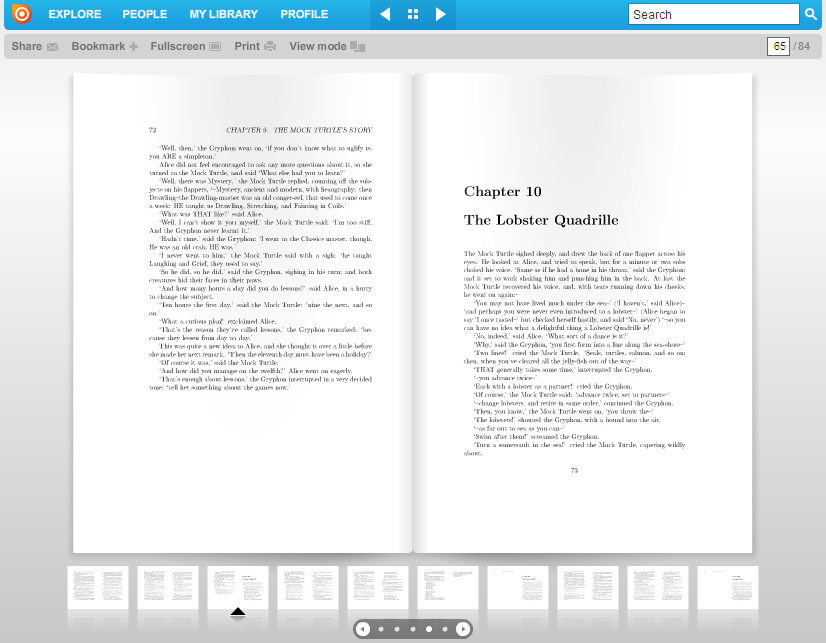
Issuu (not a typo) is a new PDF web publishing service, and it is a very good service.  You can upload a document in PDF format, and Issuu presents it in a reader that is both intuitive and easy to use.

Screenshot of Issuu

As an alternative to Google Docs or Scribd (both also excellent services) Issuu is well worth exploring.

found via PDF World

Posted in Uncategorized | Tagged , , , , , | Comments Off on Issuu PDF Publisher

Oil and Journals

Mike Dunford writing in of The Questionable Authority has written a post that compares the business model and profits of journal publishers with oil companies.  One figure that he arrives at is shocking, to say the least, but also illustrative of the current journal market:

Gas prices are going up. You’ve been combining trips, cutting your milage as much as you can, driving a more efficient vehicle, and your fuel costs are still going up. You drive home from work, stopping along the way to put $30+ dollars worth of gas into the 10 gallon tank in your Prius. You sit on the sofa, turn on the news, and hear that Exxon-Mobil just reported quarterly profits of about $1,500 per second. The price of something that you need to buy is going through the roof, it’s making things inconvenient for you, and the people who sell it are making money faster than the mint can print it. How happy are you?

If you want to understand the anger that the major publishing houses are generating, that’s a good place to start.

Publishers don’t make money at anything close to the clip that Big Oil does, but they’re not doing badly. Elsevier is probably the biggest fish, and they come in at a respectable $1,700 per minute. That’s 60 times less than Exxon-Mobil, but it’s still a nice chunk of change.

He goes on to discuss the relationships between authors and publishers, and the reaction to the open access movement.  All in all, this is a good essay that can provide some perspective for those outside of the library and publishing worlds.

found via Open Access News

Posted in Libraries, Open Access, Periodicals, Publishing | Tagged , , , , , , , , | Comments Off on Oil and Journals