Tech Static

The Tech Static is, as stated on the site, “Your collection development resource for technology titles”.

They are using a blog to house reviews of technology books and resources, and are planning to publish monthly.  It looks as though they will become an excellent resource not only for collection development, but for personal selections as well.  I am looking forward to their reviews!

from Librarian.net

Posted in Acquisitions, Blogs, Books, Libraries | Tagged , , , , , | Comments Off on Tech Static

Free Open Courseware Open Source Classes

100 Free Open Courseware Classes About Open Source Everything is a post on the BSchool.com Blog.  Their list is quite comprehensive, with something for just about anyone.

In addition, the blog has a thing for “100 Free…” lists, from resource for doing business in China, to Ivy League business courses.  They just started up last month, but I think this might be one of those resources that will provide answers for questions beyond the obvious business school related information.

found via an e-mail from Kelly Sonora (affiliated with BSchool.com blog)

Posted in Blogs, Open Source, Training, Tutorials | Tagged , , , , , | 1 Comment

OCLC Proposed Policy Text

As an accompaniment to this and this, I am including the text of OCLC’s proposed policy which was posted briefly yesterday before being removed and replaced with “We are reconsidering some aspects of the policy. More information will be available in the near future.”

Debate and discussion are healthy, especially in world of libraries.  Understanding why this policy was proposed, and why it bothers some people, is critical to the understanding of who we are and where we are going.

The text located within this post has been copied from http://marc.coffeecode.net/oclc_2008_11_02/.  I did not see OCLC’s page, and cannot guarantee that it is unchanged.  I have no reason to believe that it isn’t what existed on OCLC’s site on Sunday.

Much of what is contained here is fair and reasonable; at issue, I believe, is the concept of controlling the data contained within OCLC records through licensing.  I feel that the removal of the policy from their website is a signal that OCLC is truly attempting to do what is right for all involved, and that they can craft a policy that will express that.  This is not the 800 pound gorilla that will get it’s way no matter what, but a tiger whose instinct is to protect its territory.  We should respect that territory, while at the same time respecting our own rights to the data at issue.

The text of the since-removed policy:

———————————————————————————————-

Policy for Use and Transfer of WorldCat® Records

The Guidelines for the Use and Transfer of OCLC-Derived Records have been updated to become the Policy for Use and Transfer of WorldCat Records. The policy is scheduled to become effective mid-February 2009, to give OCLC member libraries and other organizations time to implement any changes resulting from the update. Until that time, the Guidelines will remain in effect.
Policy for Use and Transfer of WorldCat® Records
A. Intent of the Policy

OCLC® encourages and supports the widespread, non-commercial use of WorldCat Records (as defined below) for scholarship and research in furtherance of innovation that complements OCLC’s products and services for the benefit of libraries, museums, archives and other cultural heritage institutions and their respective patrons by

1. promoting the evolution of libraries, archives, museums and other cultural heritage institutions, the use of their collections and the advancement of their professions;
2. increasing availability of library, archive, museum and other cultural heritage institution resources to individual users; and/or
3. furthering ease of access to and use of world-wide scientific, literary and educational knowledge and information.

This “Policy for Use and Transfer of WorldCat® Records” is designed to foster such use while protecting the rights of OCLC’s membership and its investment in WorldCat, and ensuring that the use of WorldCat Records hereunder provides a benefit to the OCLC membership. Benefit to the OCLC membership may take the form of reciprocal linking, metadata, remuneration, services-in-kind or other negotiated value. This Policy governs all Use and Transfer of WorldCat Records unless a separate written agreement is made with OCLC. Please read the entire Policy and the documents incorporated herein by reference to ensure full understanding of the Policy.

This Policy covers WorldCat Records as defined below. This Policy may also govern the Use and Transfer of WorldCat bibliographic data available through other services to the extent determined by OCLC. Please check the FAQ regularly for the applicability of this Policy to other services.
B. Definitions

1. “Policy” means this “Policy for Use and Transfer of WorldCat Records”, as modified by OCLC from time to time.
2. “WorldCat” is the OCLC online union catalog, an electronic database of bibliographic records and other information maintained by OCLC;
3. A “WorldCat Record” is a bibliographic record meeting one or more of the following criteria unless otherwise specified by this Policy:
1. a bibliographic record obtained directly from WorldCat through the use of an OCLC product or service; or
2. a bibliographic record (i) identified as Derived from WorldCat by the party from which the WorldCat Record is received; or (ii) which is otherwise known by the recipient to have been Derived from WorldCat at any time prior to receipt. Please see the FAQ for information on fields, subfields and other factors that can indicate whether a bibliographic record has been Derived from WorldCat.

The Use and Transfer of data extracted from a WorldCat Record is subject to this Policy whether or not the extracted data itself meets one or more of the criteria described in this Section B.3 and shall be included within the term “WorldCat Record”.
An OCLC Member or Non-OCLC Member may Use or Transfer the following without complying with this Policy: (i) a WorldCat Record designated in WorldCat as the Original Cataloging of the OCLC Member or Non-OCLC Member; or (ii) a bibliographic record which is not Derived from WorldCat whether or not the OCLC Member or Non-OCLC Member adds the OCLC control number to the record.
4. A bibliographic record in WorldCat is designated as the “Original Cataloging” of the agency represented in the OCLC MARC 040 field, subfield a (original cataloging agency).
5. The “FAQ” is the Frequently Asked Questions document providing more information regarding this Policy, as updated by OCLC from time to time, which is located at: http://purl.org/oclc/wcrup-faq.
6. An “OCLC Member” is an organization that is listed on OCLC’s membership roster as a Governing Member or Member of OCLC.
7. A “Non-OCLC Member” is any party (including an individual) who is not an OCLC Member.
8. A bibliographic record is “Derived” from WorldCat if it was copied or otherwise obtained from WorldCat at any time prior to receipt.
9. “Use” means use in accordance with the requirements and intent of this Policy without making a Transfer to another person or organization.
10. “Non-Commercial Use” means Use for the purposes of research, teaching, scholarship or private study provided such use is not Commercial Use.
11. “Commercial Use” means Use in any manner that supports, is intended for or directed toward or results in commercial advantage or monetary compensation, including, without limitation, any sale of WorldCat Records.
12. “Reasonable Use” means Use of WorldCat Records that is reasonable for the intended Non-Commercial Use and consistent with the intent of this Policy. Without limiting the foregoing, the term “Reasonable Use” does not include any Use of WorldCat Records that:
1. discourages the contribution of bibliographic and holdings data to WorldCat, thus damaging OCLC Members’ investment in WorldCat, and/or
2. substantially replicates the function, purpose, and/or size of WorldCat, for example for the purpose of providing cataloging services to libraries or other organizations. Please see the FAQ for a discussion of Z39.50 for cataloging using WorldCat-derived bibliographic records.
13. “Transfer” means conveyance to another OCLC Member or Non-OCLC Member by exchange, merger, sharing, gift, providing the capability to download or otherwise electronically copy or any other means.
14. “Commercial Transfer” means Transfer of WorldCat Records for Commercial Use by the recipient.
15. “Holdings” means OCLC institution symbols attached to a record, indicating libraries that own, license or otherwise provide access to the item described by the record. An OCLC institution symbol is a unique identifier assigned by OCLC to Members.
16. “WorldCat Record Use Form” means the form prescribed by OCLC for purposes of contacting OCLC with proposals for Use and/or Transfer of WorldCat Records which are not authorized by this Policy. The WorldCat Record Use Form is located at: http://purl.org/oclc/wcrup-form.

C. Use of WorldCat Records

1. Each OCLC Member and Non-OCLC Member may Use WorldCat Records in accordance with this Policy.
2. Subject to the restrictions set forth in this Policy, OCLC Members and Non-OCLC Members are granted the non-exclusive, world-wide, royalty-free right to:
1. reproduce WorldCat Records, incorporate WorldCat Records into works and base works on WorldCat Records; and
2. display WorldCat Records, works incorporating WorldCat Records and works based on WorldCat Records;
for Non-Commercial Use.
3. The following restrictions apply to Use of WorldCat Records:
1. Reasonable Use. Use of WorldCat Records authorized by this Policy is limited to Reasonable Use except as otherwise authorized by written agreement with OCLC.
2. Commercial Use Prohibited. Commercial Use of WorldCat Records is prohibited unless OCLC has entered into a separate written agreement with the party wishing to make such Use. [OCLC has a standard agreement available which authorizes the processing (for a fee) of WorldCat Records received from OCLC Members and Non-OCLC Members.] The WorldCat Record Use Form should be used to initiate discussions with OCLC regarding an agreement authorizing Commercial Use of WorldCat Records. OCLC may refuse to authorize Commercial Use of WorldCat Records, without liability, in its sole discretion.

D. Transfer of WorldCat Records

1.
1. Subject to the restrictions set forth in this Policy, an OCLC Member may Transfer WorldCat Records of its own Holdings to other OCLC Members and Non-OCLC Members for Use in accordance with this Policy.
2. A Non-OCLC Member may Transfer WorldCat Records of its own Holdings to OCLC Members and Non-OCLC Members under separate agreement with OCLC. The Non-OCLC Member wishing to make such a Transfer must submit a WorldCat Record Use Form to OCLC for approval of the proposed Transfer. OCLC’s approval of the Transfer described in the WorldCat Record Use Form: (i) must be in writing; (ii) may be conditioned upon agreement to additional terms and conditions determined by OCLC; and (iii) may be withheld by OCLC, without liability, within its sole discretion.
2. The following restrictions apply to Transfer of WorldCat Records:
1. Attribution. WorldCat and OCLC Online Computer Library Center, Inc. must be clearly identified as the source of WorldCat Records Transferred. Please see the FAQ for information about appropriate attribution of WorldCat and OCLC.
2. Modification Restriction. The OCLC number (if any), the link to this Policy and any additional means of attribution (besides the link to this Policy) may not be removed from any WorldCat Record.
3. Commercial Transfer Prohibited. Commercial Transfer of WorldCat Records is prohibited unless OCLC has entered into a separate written agreement with the party that will receive the WorldCat Records. The WorldCat Record Use Form should be used to initiate discussions with OCLC regarding an agreement authorizing Commercial Transfer of WorldCat Records. OCLC may refuse to authorize Commercial Transfer of WorldCat Records, without liability, in its sole discretion.
4. Copy of Policy. If an OCLC Member Transfers WorldCat Records of its own Holdings under Section D.1.a above, the OCLC Member will provide the party receiving the WorldCat Records with a copy of this Policy (or a link by which this Policy may be accessed) and indicate that Use and Transfer of WorldCat Records is permitted only in accordance with the Policy.
3. The Transfer of WorldCat Records by an OCLC Member or Non-OCLC Member which do not represent its own Holdings requires submission of a WorldCat Record Use Form to OCLC for approval of the proposed Transfer. OCLC’s approval of the Transfer described in the WorldCat Record Use Form: (i) must be in writing; (ii) may be conditioned upon agreement to additional terms and conditions determined by OCLC; and (iii) may be withheld by OCLC, without liability, within its sole discretion.
4. WorldCat Records, a work incorporating WorldCat Records or a work based on WorldCat Records which are Transferred may be Used by the recipient only under the terms of this Policy. Additional or different terms may not be imposed. Any link to this Policy in a WorldCat Record that is Transferred may not be removed, hidden, deactivated or obscured.

E. Additional Provisions

1. The rights to Use and Transfer WorldCat Records afforded by this Policy shall automatically terminate upon any breach of the terms of this Policy. The OCLC Member(s) and/or Non-OCLC Member(s) involved in any breach of this Policy shall provide such assistance as is reasonably requested by OCLC to remedy the breach.
2. WORLDCAT RECORDS ARE PROVIDED AND/OR MADE AVAILABLE “AS IS”. NEITHER THE ORIGINAL CATALOGING LIBRARY NOR OCLC WARRANTS THE COMPLETENESS OF WORLDCAT RECORDS.
3. Neither this Policy nor the transactions contemplated herein serve to transfer any ownership right or interest in or to WorldCat or WorldCat Records, including, without limitation, the intellectual property rights therein.
4. When an organization makes bibliographic information available to OCLC which is subject to Use or Transfer restrictions which are different than those set forth in this Policy, and OCLC nevertheless elects to accept the information for addition to WorldCat, OCLC will inform OCLC Members and Non-OCLC Members of the restrictions, and the rights to Use and Transfer such information will be subject to such restrictions.
5. Regardless of the source from which WorldCat Records are received, Use and Transfer of WorldCat Records is authorized solely by OCLC pursuant to this Policy. Accordingly, this Policy constitutes a direct contractual relationship between OCLC and the party obtaining WorldCat Records, and may be enforced by OCLC directly against such party.
6. OCLC has the sole discretion to determine whether any Use and/or Transfer of WorldCat Records complies with this Policy. In the event OCLC identifies a Use and/or Transfer which does not comply with this Policy, OCLC shall notify the relevant OCLC Member(s) and/or Non-OCLC Member(s) and such parties agree to work with OCLC to resolve the noncompliance.
7. This Policy is the final, complete and exclusive statement of the agreement of the parties with respect to the subject matter hereof. Once applicable to a given Use or Transfer of WorldCat Records, no provision of this Policy may be changed, modified or supplemented except in a written document signed by the parties. OCLC may issue a modified version of this Policy or a substitute for this Policy at any time and the modified or substitute version will apply to any Use and Transfer of WorldCat Records after the date of issuance (or other effective date specified by OCLC).
8. If any provision of this Policy is invalid or unenforceable under applicable law, it shall not affect the validity or enforceability of the remainder of the terms of this Policy, and without further action by the parties to this agreement, such provision shall be reformed to the minimum extent necessary to make such provision valid and enforceable. No term or provision of this Policy shall be deemed waived and no breach consented to unless such waiver or consent shall be in writing and signed by the party to be charged with such waiver or consent.
9. This Policy shall be governed by and interpreted in accordance with the laws of the State of Ohio and the United States of America, without regard to principles of conflict of laws, except (i) as otherwise provided in a separate agreement with OCLC which incorporates this Policy; or (ii) as otherwise required by applicable law.
Posted in Cataloging, Libraries, Licensing, OCLC, Online Databases, Online Services, OPAC | Tagged , , , , , , , , , , | 1 Comment

OCLC WorldCat is the Tiger, not the Lady?

OCLC released their updated Policy for Use and Transfer of WorldCat Records yesterday, with implementation scheduled for mid-February.  If you see the phrase

We are reconsidering some aspects of the policy. More information will be available in the near future.

then you might suspect that it created quite a fuss.  It did, and OCLC responded by removing the policy from their web site.

Someone saved a copy of the web page; I will include the text of the policy in the next post.

The core criticism of the policy changes seem to revolve around the licensing of the records.  OCLC planned to include a license statement in a 996 field (from Terry’s Worklog):

996 $aOCLCWCRUP $iUse and transfer of this record is governed by the OCLC® Policy for Use and Transfer of WorldCat® Records.
$uhttp://purl.org/oclc/wcrup

Limits would include use of the records in anything that “substantially replicates the function, purpose, and/or size of WorldCat, for example for the purpose of providing cataloging services to libraries or other organizations.”  Cataloging services aside, how large does a union catalog have to be before it replicates the function of WorldCat, namely finding a library that owns a particular book?  Ohio’s Ohiolink sized?  Illinois’ I-Share sized?  Georgia’s Pines sized?

What about the OpenLibrary project?  Or LibraryThing?  Using information derived from an OCLC record without including the OCLC number and other OCLC references (like the above statement) would violate their terms, as I read them.  However, the last time I checked, the data itself is not covered under copyright and should be able to be extracted and expressed in creative ways (as long as OCLC’s creative way of expressing the data is not infringed).

We need to recognize the difference between the data held in these records and the expression of that data.  To enter into license agreements that suggest that we cannot recognize the data separate from the expression goes against core library principles.  This feels, in some ways, like the Major League Baseball statistics copyright battle from a few years back, in which the idea of the data itself being public domain was upheld.

One final note:  keep in mind the who and how behind the creation of these records.  We create them.  OCLC gathers them, disseminates them, and puts them to mostly good use.  If OCLC didn’t exist, there would be a need for some organization with a similar purpose.  They are not evil, they are not out to get us; they are, however, overreaching at times.

originally found via Thingology

Posted in Cataloging, Copyright, ILS, Libraries, Licensing, News, OCLC, Online Databases, Online Services, OPAC | Tagged , , , , , , , , , , , | 2 Comments

The Final Opus

I thought it both appropriate and noteworthy for the final Opus comic to end on a literary note:

The final strip, minus the final panel.

The final panel.

via LISNews

Posted in Books, Humor | Tagged , | Comments Off on The Final Opus

Google Book Search Copyright Settlement

Google has reached a settlement with the group of publishers who filed suit in 2005 over the book digitization project.  It is a legal document with many elements, and I cannot hope to make an overall evaluation of the agreement with just the amount that I have browsed (much less with my limited ability to discern the true meaning of legalese).  However, there are a couple of sections that raise questions:

7.2 Fully Participating Library Uses… (b) Use of Library Digital Copies… (vii) Personal Scholarly Use and Classroom Use. The Fully Participating Library, if part of a Higher Education Institution, may allow faculty members and research staff of that Higher Education Institution to read, print, download or otherwise use up to five (5) pages of any Book from its LDC [Library Digital Copy] that is not Commercially Available for the following purposes: (1) personal scholarly use (for each Book, no more than once per person per term) and (2) classroom use in such Higher Education Institution that is limited to the instructors and students in the class and for the term in which the class is offered; provided that (a) the Fully Participating Library does not know at the time of such use that it is in material non-compliance with Section 8.2 (Security Standard, Security Implementation Plan and Security Audits) with respect to uses of the LDC authorized pursuant to this Section 7.2(b)(vii) (Personal Scholarly Use and Classroom Use), and (b) the Fully Participating Library keeps track of and reports all such uses of Books to the Registry in the course of the audit conducted pursuant to Section 8.2(c) (Audits) or, otherwise, upon reasonable request of the Registry, provided that such requests may be made no more than semi-annually. The Registry may make information from such reports regarding the usage of an individual Book available to the Rightsholder of such Book upon request of the Rightsholder. A Fully Participating Library may not read, print, download or otherwise use a Book or Insert through its LDC pursuant to this Section 7.2(b)(vii) (Personal Scholarly Use and Classroom Use) if such use is available through the Institutional Subscription and the Institutional Subscription service is offered or is available to the Fully Participating Library (whether for a fee or as a beta product) at the time such Fully Participating Library seeks to make such use.” (page 76)

The agreement defines Commercially Available as “…that the Rightsholder of such Book, or such Rightsholder’s designated agent, is, at the time in question, offering the Book (other than as derived from a Library Scan) for sale new through one or more then-customary channels of trade in the United States.” (Section 1.28 on page 4)  Does this mean that if a researcher or faculty is able to read (or print) only up to 5 pages of the scanned book each semester for personal scholarly use – and then only if the book is not able to be purchased through “customary channels of trade”?

Am I interpreting this correctly?  Is this not a severe restriction of the “Fair Use” clause of copyright?  Why would a researcher want to agree to such limitations when the physical item allows for a broader use?  I may be misreading this section, however, and hope to have it clarified in the near future.

Another section that gives me pause:

Section 3.8 (b) Effect of Changes in Law. Google will be able to take advantage of any future legislative change(s), such as legislation allowing the use of orphan works (if enacted), that put Google at a competitive disadvantage in its use of Books in any Google Products and Services that are subject to this Settlement Agreement; provided, however, that Google may choose to receive the benefit of such change(s) only if a third party is actually taking advantage of such law(s) in connection with services that competitively disadvantage Google in its provision of any such Google Products and Services; provided, further, that no changes in the “fair use” doctrine as codified in Section 107 of the Copyright Act shall trigger this Section 3.8(b) (Effect of Changes in Law).” (page 37)

So if a legislative body, such as the United States Congress, passes a law that allows for broader use of this type of material (i.e. a change in copyright law), Google can only put the broader use into Google Books if it can demonstrate that another company is already taking business away from them by implementing it; otherwise, Google must keep the higher restrictions in place.

In addition, what happens if “fair use” is broadened?  It won’t trigger this section.  Does that mean that Google can follow fair use, or that Google cannot?  The fair use provision seems to be placed on an equal footing as the “competitively disadvantage” clause.  Does Google pass along the broader use understanding, or does it just pass?

For better or worse, this settlement is going to dramatically change how libraries use electronic books.  Hopefully the overall agreeement implements a positive experience for all parties involved, and that my concerns (and the concerns of others) are either misread clauses or taking a section out of context.

The element of this agreement that holds great promise is the potential for institutional access to the entire collection of scanned books.  Imagine having millions of books available to our patrons via a usable and cost-effective agreement.  We are moving towards the future; are we ready for it (and the future for us)?

Further information and links:

Posted in Books, Copyright, Fair Use, Google, Libraries, Library 2.0 | Tagged , , , , , , , , , , , , , | Comments Off on Google Book Search Copyright Settlement

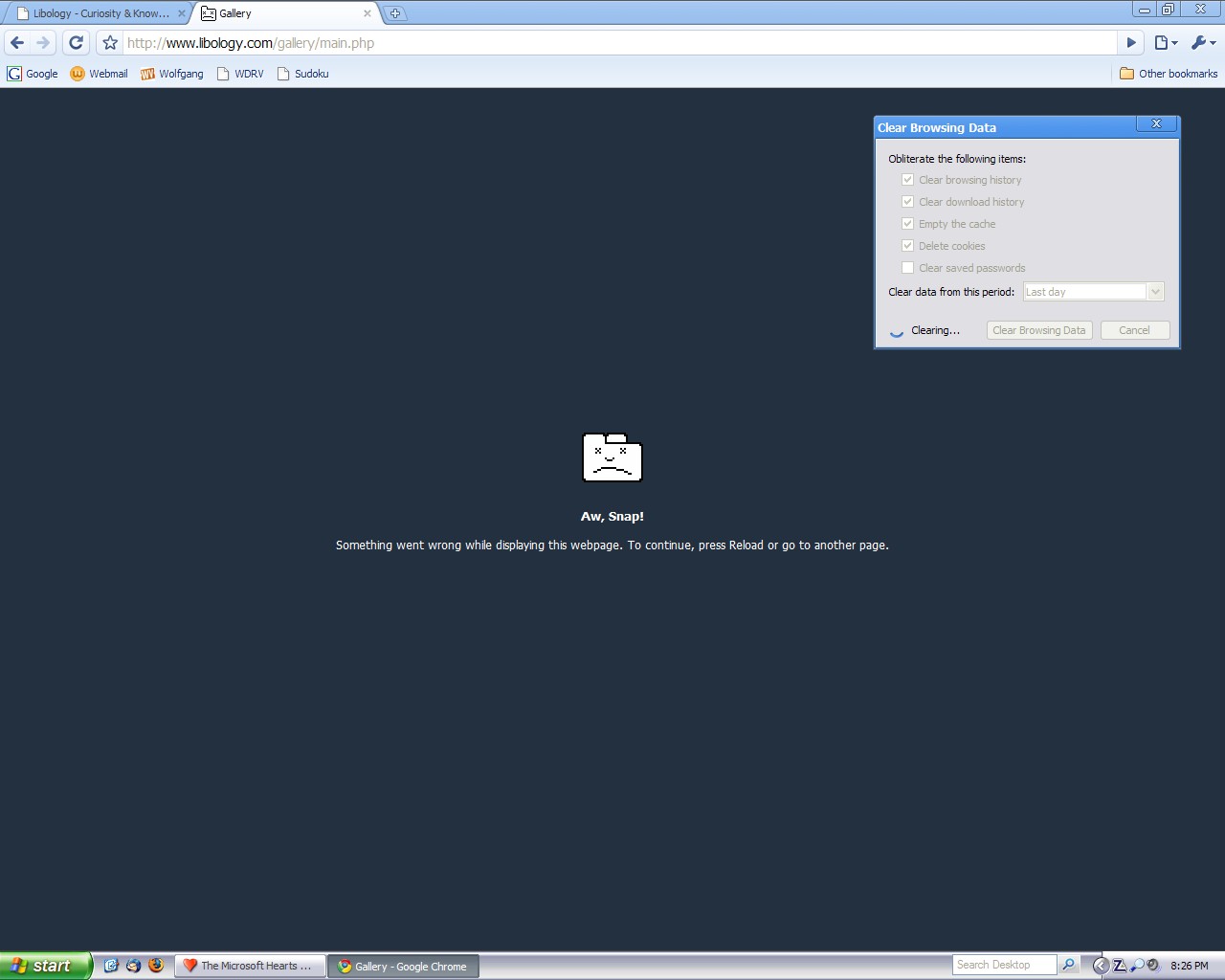
Aw, snap!

On a lighthearted, and non-library, note:  here is a screenshot of what the Google Chrome browser shows when a web page goes kaploee:

Aw Snap

Posted in Google, Software | Tagged , , | Comments Off on Aw, snap!

Blogs in the Liblog Landscape

Walt Crawford has posted his list of 607 library-related blogs (this one included).  This is as definitive and current a list as one is likely to find, and Walt has done an excellent job compiling and checking the links.

If you cannot get your fill of library blogging from this source, then you are more hard core than I.

found via Walt at Random (also included)

Posted in Blogs, Libraries, Library 2.0 | Tagged , , , | 1 Comment

Been There, Done That

Male library assistants, you are probably familiar with this experience

(I was announced this way when I attended a (non-library) administrative assistant workshop as the only male participant, once… memories!)

Posted in Humor, Libraries | Tagged , , , , | Comments Off on Been There, Done That

Social Networks and College Students

The 2008 ECAR (EDUCAUSE Center for Applied Research) survey has been released, and they have added a section on social networking (pdf version of chapter here).  Among the findings:

  • Slightly over 85% of those surveyed use social networks, with Facebook and MySpace topping the list.
  • Younger students (under 30) tended to use Facebook, while older ones tend towards MySpace.
  • About 50% use social networking for discussing classwork with other students; only about 5% use it for discussing classwork with instructors.

The only one of these three that surprised me was the tendancy towards Facebook/MySpace by age.  I have thought of MySpace as appealing to younger users than Facebook.

Social networks are definitely here to stay.  In five years we may not be discussing Facebook or MySpace (because they might have been superceded by a yet un-created network), but people will be more interconnected, not less.

The third point is one that should make us take notice.  Half of the surveyed students have used social networks to discuss classwork; the main reason they haven’t discussed it with instructors (and by extension, the library folk) is that we view it as some sort of cyber malt shop, a place only for their peers.

If we make ourselves available on social networks, we aren’t going to find ourselves becoming an overnight sensation.  We will, however, give people one more way to view us as being there to assist them.

Whether we create OPAC search tools to embed (or even highlight the good ones that exist, like WorldCat and CiteMe in Facebook – also here), create an institutional identity, or just make ourselves more visible as individuals, there is much we can do to assist students and promote our services.

We can jump on board the trolley, or be left behind.  The choice is ours, both individually and collectively.  I am on Facebook and LinkedIn, btw… and you should be too.

found via Web4Lib — thanks Gerry McKiernan!

Posted in Education, Libraries, Library 2.0, OCLC, Online Services | Tagged , , , , , , , , , , | 1 Comment

International Music Score Library Project

The International Music Score Library Project is a great concept:  a collection of public domain musical scores made freely available to musicians, composers, and everyone else as well!

Note also that the site was built using MediaWiki software.

found via MetaFilter

Posted in Online Services, Wiki | Tagged , , , | Comments Off on International Music Score Library Project

Check Out My Cool New Sweater

When Tears for Fears created a video for their song Head Over Heels way back in the 1980s, they used a library for the set.  The lyrics, however, had nothing to do with libraries.

This has been corrected:

thanks to Franny Oxford!

Posted in Humor, Libraries | Tagged , , , , , , | 1 Comment

OpenOffice.Org 3.0

OpenOffice.Org released version 3.0 of their office suite on Monday.  The changes aren’t dramatic, but it is definitely a step forward for the user in many ways.

Also of note:  this is the first version of OpenOffice that runs natively on Macintosh!

via

Posted in Open Source, Software | Comments Off on OpenOffice.Org 3.0

What We Need

The cover story for the October issue of Library Journal is titled What We Need.  It centers on the results of a survey of Movers & Shakers, the annual group of people recognized by Library Journal for innovation and leadership.  It contains a lot of great information, and even a few surprises.

Most of all, if you are in a job situation where people are not encouraged or rewarded for innovation, don’t feel that you are isolated and alone.  Many of those surveyed come from similar circumstances.  What emerges from this article is not so much the people who excel because of a supporting environment and management, but in spite of it.  Most received more support and encouragement from their peers at work than from their supervisors.

What surprised me so much that I had to put down the article and simply let it sink in was the following passage:

Nearly half of all respondents (48.6%) stated that their organization did not celebrate their being named as an LJ Mover. Many of the total respondents commented that internal recognition was limited to a librarywide email from the director or a brief comment at a staff meeting.

Think about that.  Library Journal picks about 50 people each year to recognize their enthusiasm and contributions to libraries.  Nearly half of their workplaces didn’t think this recognition important enough to celebrate.  My first thought was about the unhealthy workplaces; however, that large of a number signifies to me a sickness in the profession.  Consider the following:

Some respondents noted that the recognition from outside of the library actually hurt their work life. When asked if and how their being named a Mover was celebrated, one respondent answered “not at all, created a lot of problems.” Another noted “friends and colleagues celebrated; administration ignored the award.”

These are the cream of the crop!  How many potential Movers & Shakers (and I am not limiting this to those officially recognized as such) have been demoralized over the years by this environment?  More importantly:  what can we do about this?

Simply put:  celebrate innovation, wherever it may come from.  Support your coworkers, whatever their “level” or title, when they succeed at something new.  Support them even more when they fail… the attempt is of the utmost importance.

I feel strongly for these people when I hear these stories, because I have experienced those environments.  I know people who are still existing in situations that rob most people of their enthusiasm for libraries. I can tell stories, but often do not because of the pain and frustration the memories invoke.  Not only careers but lives can and do get ruined.

What you can do is this:  Take heart, and keep on striving to do everything you can to learn, and apply what you learn.  Try… Fail… Try again.  Support each other, because sometimes all you have is each other.

Just keep at it.

Posted in Libraries | Tagged , , , , , , | Comments Off on What We Need

Five drafts and One Sophie Book ago…

If you don’t have it already, install the Sophie Reader on your computer and take a look at this version of Abraham Lincoln’s Gettysburg Address.

It features five drafts of the famous speech, displayed so that you can compare and contrast the different versions and gain an insight into Lincoln’s approach to speechwriting.

Oh, and it also has an audio layer:  Johnny Cash reading the speech.

from if:book

Posted in Books, History | Tagged , , , , , | Comments Off on Five drafts and One Sophie Book ago…

2008 Presidential Election Search Engine

The 2008 Presidential Election Search Engine is a Google Custom Search Engine created by the University of Kansas Library.

It is a great resource in that one can find the needles of information in the haystack of campaign rhetoric.

found via “Organizing the 2008 Presidential Election”, from College and Resource Libraries, October 2008, p. 540.

Posted in Government, Libraries, News, Politics, Search, WebSearch | Tagged , , , , , , | Comments Off on 2008 Presidential Election Search Engine

Confusing Traffic Signs

Two planets of coincidence had to converge for me to make this decidedly non-library post:

  1. I posted a reference to the Manual of Traffic Signs a couple of months ago.
  2. I am familiar enough with example number three from DeKalb, Illinois to know what intersection it represents.

So, enjoy America’s 10 Most Confusing Traffic Signs!

from Metafilter

Posted in Humor | Tagged , , , , | Comments Off on Confusing Traffic Signs

Text Yourself from the OPAC

I am playing catch-up in many areas right now, and as a result there hasn’t been as much activity here.  Hopefully the time of less activity has reached a middle…

An interesting new feature that has begun to appear in OPACs is the ability to send the location/call# of an item to your cell phone as a Short Message Service (SMS) text.  The Iowa City Public Library has implemented this into their Innovative (III) catalog, as you can see in this example.  It becomes the equivalent of writing yourself a quick note for when you are physically in the library to find the item.

While this service might seem to be targeted to a small portion of library users, I suspect that it is worthwhile to implement. if only because the people who will use it will find it exceptionally handy.

found via The Shifted Librarian

Posted in ILS, Libraries, Library 2.0, Online Services, OPAC, Web Design | Tagged , , , , , | Comments Off on Text Yourself from the OPAC

Stories Behind 10 Dr. Seuss Stories

Stories Behind 10 Dr. Seuss Stories is a post at the Mental Floss blog with information about the inspirations (and representations) behind several of the great books by Theodor Seuss Giesel.

via LISNews

Posted in Books, History, Publishing | Tagged , , , | Comments Off on Stories Behind 10 Dr. Seuss Stories