DIY Book Scanner

I enjoy building things, especially if there is a “let’s see what we can find to make this work” factor involved.

With that in mind, it should be obvious why Building a High Speed Scanner from Trash and Cheap Cameras has me salivating.  I think I shall have to examine the materials and time needed for this…

found via Librarian.net

Posted in Books, Tutorials | Tagged , , , | Comments Off on DIY Book Scanner

E-Readers and the Future

ALA TechSource has a brief blogger forum post on the state of E-Book Readers.  The quote that I think is most worth thinking about comes from Jason Griffey:

E-books are the future of reading in a very real way, simply because at some point they will be too cheap to not use. One of my staff brought a receipt to me this week for a laptop that the library bought in 2000. It was $3600. I just priced netbooks for my library, and can get a machine that is ridiculously more powerful than the year-2000 laptop for under $350. The Kindle, and most other e-readers, are hovering around the $350 or so dollar mark right now. In ten years, what will they cost? How can paper continue to compete with Moore’s Law?

Not only does it make sense, for reasons of legality (terms of use) and usability, to wait before purchasing and implementing E-Readers in a library, but it also makes sense from a monetary standpoint.  Amazon’s Kindle is king of the hill right now, but I think the big one is yet to arrive.  Watch for it, however:  when the convergence of price, usability, and usefulness happens, you want to be ready.

Posted in Blogs, Books, Libraries, Licensing, Publishing | Tagged , , , , , , , , , , , | 2 Comments

A Periodic Table of Visualization Methods

A Periodic Table of Visualization Methods is a great resource if you have information you need to present visually, but don’t know the best way to express it.  Simply go to the site and let your mouse hover over the examples in the different categories.  Note the creative use of the Periodic Table structure.

A word of caution:  too often people fall into the trap of using a visualization method that they find appealing, but that doesn’t quite fit their information.  In addition, focusing on the presentation of information at the expense of Keeping It Simple (a.k.a. Style vs. Substance) can lead to a result that looks great but doesn’t say anything relevant.

found via Dysart & Jones

Posted in Classification, Web Design | Tagged , , , | 2 Comments

Oracle buys Sun

Oracle has purchased Sun Microsystems.

This is significant on many levels.  Many of our library systems run on software or hardware from these companies.  The Voyager library I used to work for used an Oracle database running on a Sun Solaris server.  The clients (Circulation, Cataloging, Acquisitions, etc.) for III’s Millennium system run on Java.

Many web-based software platforms use MySQL (an open-source database project owned by Sun), including many, many blogs (including this one) wikis and CMS.

Many of us use OpenOffice as either their primary or as an additional office suite.

I am not saying that we are at risk for losing these foundations of our library and internet software programs.  The fact that OpenSolaris, Java, MySQL, and OpenOffice are all open source means that we can trust that they will be with us in some form for as long as there is a demand (a trust that cannot be equally placed with any closed source software, which can disappear with the collapse or acquisition of the company holding the software rights).

What I am sure of is that we will see changes.  Oracle has a strategy, or if it doesn’t, it will.  Some of these programs will likely see greater support and resources (hopefully OpenOffice), others will likely see less (hopefully none of them).  Some may become more focused towards a particular segment of the technology world (watch MySQL for this possibility).

Look at what you use, and recognize that today marks a turning point for some of the software.   Hopefully it is for the better.

found via TechCrunch and MetaFilter

Posted in Acquisitions, Blogs, Cataloging, ILS, Libraries, News, Online Databases, Online Services, Open Source, Software, Wiki | Tagged , , , , , , , , , , , , , , , , , , , | Comments Off on Oracle buys Sun

Evernote

Evernote is an online service that serves an interesting purpose:  it allows you to indicate digital items that you wish to remember, it stores them, and then makes the entire collection searchable.

Or more specifically, you can have it remember all your blog posts, tweets, iPhone items (photographs, etc.), typed notes, e-mails… whatever you tell it to store.  Everything gets indexed in their database, and will be there for you to retrieve at whatever time you wish to do so.

Right now this is simply a neat idea, and assuming that it works as smoothly as it’s description, a good way of archiving the wide varieties of communication and digital storage we use in our daily lives.  However, I think it is more than that… I suspect that this is the social leading edge of what is becoming more and more necessary in the digital age: the necessity of having some sort of structure to the hodge-podge of data that accumulates like peanut shells in a sports bar.

Another way of viewing this is that it is similar to the ideas behind the Semantic Web.  This isn’t a perfect match, of course, but the ability to match up commonalities between different chunks of data is the goal in each of these endeavors.  Understand that the amount and variation of the data is not going to be reduced in the years to come… we are going to need tools like this just to keep abreast of the tide of information that we will encounter.

Watch for other companies to address this idea; I will likely wait for something that can reside on my own server space (perhaps syncing indexes with others for greater effect), and preferably open source, rather than trust that this or some other cloud will achieve permanence.

found via the Proverbial Lone Wolf Librarian

Posted in Blogs, Online Databases, Online Services, Search, Software | Tagged , , , , , , , , , , , | 1 Comment

Open Source ILS and Technical Services

For those interested in Open Source Integrated Library Systems such as Koha, Evergreen, Open Library Environment Project (OLE), OpenBiblio, etc., the Association for Library Collections and Technical Services (ALCTS) will be holding an e-forum on April 21st and 22nd.  From the announcement:

Please join us for a free ALCTS e-forum discussion!   Participation is open to all.

April 21-22, 2009:  Open Source ILS and Technical Services:   High Risk or High Reward?

Moderated by Clint Chamberlain, University of Texas Libraries, and Rob Van Rennes, University of Iowa Libraries, members of the ALCTS CRS Acquisitions Committee.

Over the past few years, many librarians have expressed dissatisfaction with our current ILS, citing inflexible systems, high costs, and lackluster vendor service.  Some libraries have consequently pursued Open Source ILS such as OLE, Koha, and Evergreen.  Join this e-forum to share your experiences with and your questions about Open Source ILS and your thoughts on the future of the traditional, proprietary ILS.   We are particularly interested in hearing about experiences with the technical services aspects of Open Source ILS:  acquisitions, management of continuing resources, and cataloging.

Discussion will start Tuesday, April 21, 9AM EST and will conclude Wednesday, April 22, 5PM EST.

You can sign up at http://lists.ala.org/sympa/, go to the ALCTS section, then select alcts-eforum@ala.org.

I am especially interested in hearing about how the Cataloging, Acquisitions, and Circulation functions are viewed by people who use them in a production environment.  Koha and Evergreen have been making incredible progress into the library world, and I suspect that many of us will have experience with them before long.

received via SerialsT list

Posted in Acquisitions, Cataloging, Groups, ILS, Libraries, Open Source, Software | Tagged , , , , , , , , , , , , , , , , , | Comments Off on Open Source ILS and Technical Services

National Library Workers Day

Today is National Library Workers Day!  Be sure to let those who make your library experience better, whether they be coworker, boss, student, or the library workers at the place you get your materials, know that you appreciate them!  If you follow the link, you can post their information for all to see!

And if you work in a library, find some way to treat yourself to something nice today.  You deserve it!

And if you have worked in a library with me, treat yourself double… you have probably earned it! 😉

Posted in Libraries | Tagged , , , | Comments Off on National Library Workers Day

Facebook Generation vs. the Fortune 500

Gary Hamel’s blog post on the Wall Street Journal is titled The Facebook Generation vs. the Fortune 500, but the issues contained within the post are ones that are going to touch upon all businesses and organizations, including libraries.

He lists 12 “work-relevant characteristics of online life” that will impact the workplace, including:

  • All ideas compete on equal footing.
  • Leaders serve rather than preside.
  • Groups are self-defining and -organizing.
  • Power comes from sharing information, nor hoarding it.
  • Intrinsic rewards matter most.

All of these are features of organizations that are in a better position to survive, simply because members are motivated to be adaptive, communicative, and supportive.  Think about groups and workplaces you have been a member of… most of your negative associations with them likely would be less critical if one or more of the ideas above were a greater part of the environment.

These ideas will slowly creep in, championed by those who have experienced the benefits a group/organization/business gains by applying them.  Resistance will be the unspoken response by those whose power lies in control of information, expression, and rewards.

The mix of these ideas will affect different groups in different ways, but they will affect every group, including libraries, in a profound manner.  The greatest benefits go to those who can successfully adopt the attitudes and behaviors that will ultimately succeed within that group.

Which of these offers the greatest opportunity for your situation?  What can you do to begin/continue the transition?  Think about this, because it is up to you to change your own approach, and encourage others to change theirs, as well.

found via Lorcan Demsey’s Weblog

Posted in Groups, Libraries, Library 2.0 | Tagged , , , , , , , | Comments Off on Facebook Generation vs. the Fortune 500

Google Ventures and Libology

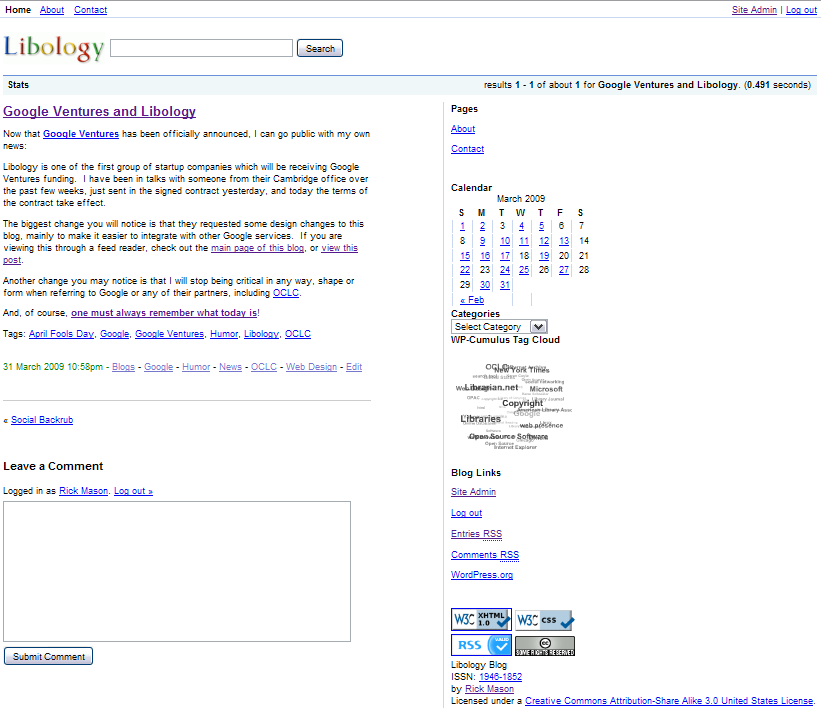
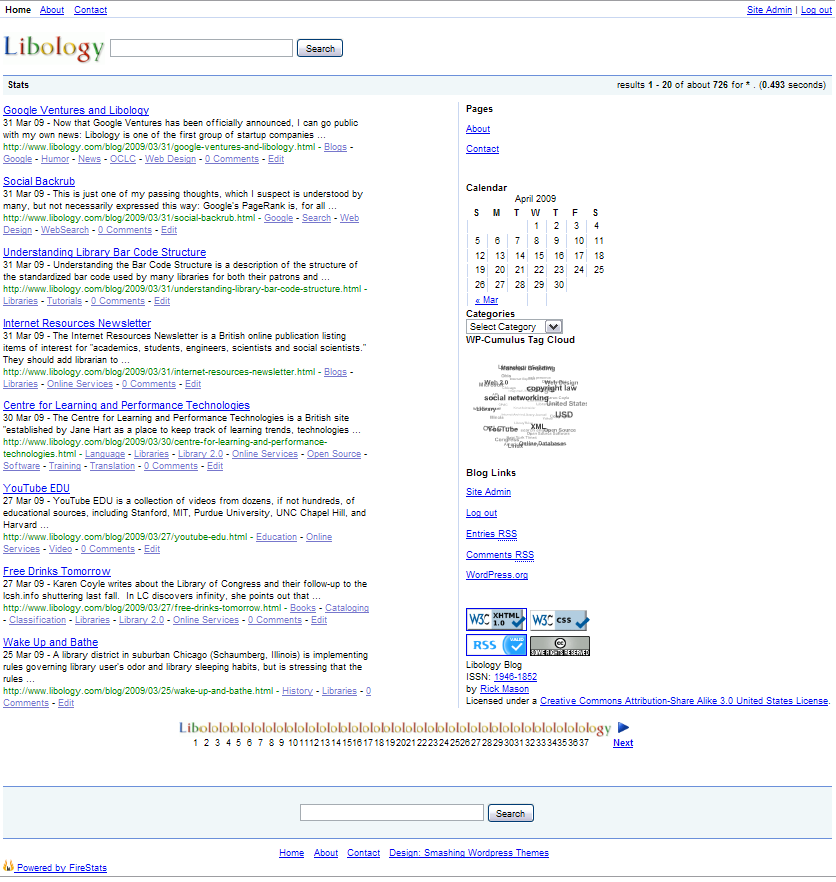
Now that Google Ventures has been officially announced, I can go public with my own news:

Libology is one of the first group of startup companies which will be receiving Google Ventures funding.  I have been in talks with someone from their Cambridge office over the past few weeks, just sent in the signed contract yesterday, and today the terms of the contract take effect.

The biggest change you will notice is that they requested some design changes to this blog, mainly to make it easier to integrate with other Google services.  (See below for screenshots)  If you are viewing this through a feed reader, check out the main page of this blog, or view this post.

Another change you may notice is that I will stop being critical in any way, shape or form when referring to Google or any of their partners, including OCLC.

And, of course, one must always remember what today is!

Google Style Main Page

Google Style Main Page

Post Googlized

Post Googlized

Posted in Blogs, Google, Humor, News, OCLC, Web Design | Tagged , , , , , | Comments Off on Google Ventures and Libology

Social Backrub

This is just one of my passing thoughts, which I suspect is understood by many, but not necessarily expressed this way:

Google’s PageRank is, for all practical purposes, a form of social networking applied to the concept of a particular html tag.  The ranking system is built upon the idea that someone, somewhere, decided that something on their web page was so associated with another web page that it needed to be wrapped in <a> </a> tags with the web page’s address referenced.  Thousands (millions!) of people finding it imperative to add these tags around their text, and thereby making it possible to judge the importance of specific web sites by aggregating these millions (billions!) of tags.  Will we look back at this and call it the beginning of social networking on the web?

the thought passed through my head while reading Stefano’s Linotype

Posted in Google, Search, Web Design, WebSearch | Tagged , , , , | Comments Off on Social Backrub

Understanding Library Bar Code Structure

Understanding the Bar Code Structure is a description of the structure of the standardized bar code used by many libraries for both their patrons and their materials.  It resides on the website of JerseyCat, New Jersey’s nicely named “statewide virtual catalog and interlibrary loan system.”

Of added interest is the inclusion of the formula for calculating the check digit.

Even if you never need this type of information for your job, it is good to know the basic philosophy behind the bar code structure.

Posted in Libraries, Tutorials | Tagged , , , , , | Comments Off on Understanding Library Bar Code Structure

Internet Resources Newsletter

The Internet Resources Newsletter is a British online publication listing items of interest for “academics, students, engineers, scientists and social scientists.”

They should add librarian to that list, because there are quite a few excellent resources in this month’s issue on the current issue, a couple that I recognize from this blog.  There are a variety of ways to subscribe, including e-mail and rss.

Disclaimer:  I am listed in their Blogorama section for April 2009; checking my traffic logs is how I found the newsletter for this post.

Posted in Blogs, Libraries, Online Services | Tagged , , , , , , , , | Comments Off on Internet Resources Newsletter

Centre for Learning and Performance Technologies

The Centre for Learning and Performance Technologies is a British site “established by Jane Hart as a place to keep track of learning trends, technologies and tools.”

Most impressive, at first glance, are the lists of free tools and resources:

Although the focus of the site is education, most of what is featured can benefit both library staff and patrons.

found via MLxperience

Posted in Language, Libraries, Library 2.0, Online Services, Open Source, Software, Training, Translation | Tagged , , , , , , , | Comments Off on Centre for Learning and Performance Technologies

YouTube EDU

YouTube EDU is a collection of videos from dozens, if not hundreds, of educational sources, including Stanford, MIT, Purdue University, UNC Chapel Hill, and Harvard Business School.

This looks to be the start of a very useful collection of lectures and informational videos.

found via The MLxperience

Posted in Education, Online Services, Video | Tagged , , , , , , , , | Comments Off on YouTube EDU

Free Drinks Tomorrow

Karen Coyle writes about the Library of Congress and their follow-up to the lcsh.info shuttering last fall.  In LC discovers infinity, she points out that at ALA Midwinter they not only stated that they recognized the value of the service, but that they were planning on re-releasing it as “Library of Congress Subject Headings” within 6-8 weeks.

Then she points out that 9 weeks have passed, with no changes on the website, nor updates as to the progress being made.

Any project, including re-implementing a service that was fully functional, can run into complications.  We have all experienced this.  The key is keeping people informed, and being realistic about solving problems.

LC should not have shut down lcsh.info in the manner they did; they should have implemented their version first, then allowed for an overlap (6 months, for instance) to give those who had integrated the service into their systems time to switch over.  What we have is a mess, and the pressure is on the Library of Congress to clean it up.

Posted in Books, Cataloging, Classification, Libraries, Library 2.0, Online Services | Tagged , , , , | Comments Off on Free Drinks Tomorrow

Wake Up and Bathe

A library district in suburban Chicago (Schaumberg, Illinois) is implementing rules governing library user’s odor and library sleeping habits, but is stressing that the rules are not aimed at homeless users of the library.

This is a little hard to believe, as they also stress that they aren’t planning to invoke the rule against patrons who fall asleep while reading, but those who go into the library with the intention of sleeping.

A little background:  I started my library career in the Brookfield (IL) Public Library, and during the winter months, we had several homeless patrons who spent many hours each day in the library.  Odors?  Definitely.  One person in particular was so strong that I had to hold my breath whenever I was within 5 feet of him.  Just writing this is evoking the exact memory of the smell.

Initially, I didn’t understand why they were allowed.  I am sure that many of our patrons left the library sooner, and perhaps didn’t return as often during the winter months.  We definitely received complaints.  But the director, someone who I have grown to respect more and more over the years, insisted on allowing them a safe haven during the freezing temperatures.

My suggested solution?  Find a way to get people the services they need.  Resources for the homeless have improved, and everyone in need should avail themselves of those resources.  If those resources aren’t available, or even if the people who need them won’t use them, do not deny to them what may be their one safe shelter.  I occasionally wonder about the people I encountered as a page, and hope that their lives improved; but even if they didn’t, I feel happy that the library I remember so fondly also served as a safe place for them.

article found via LISNews

Posted in History, Libraries | Tagged , , , , , , , | Comments Off on Wake Up and Bathe

Document Freedom Day!

Today is the second annual celebration of Document Freedom Day!

So why are open document formats important?  What happens when someone sends you a document created with Microsoft Word 2007, and saved with the default file format?  You get a file with a .docx extension, and you have to find some way to convert it or obtain it in another format.

What happens when you encounter a file from a program you used 10 years ago, when the company is out of business, and you don’t know anyone who still uses it?  This can be more challenging.

The purpose of open document formats is to ensure that the information about how the document was saved is available for any person/company to utilize.  Importers for different programs and standalone converters can be created; the files themselves can sometimes be opened using simpler means.

The most forward-thinking and useful set of open document formats are those from the OASIS project.  They are in use in several programs, but the highest profile of these is OpenOffice.org.  The Open Document Format has proven to be very robust, and stores information in a manner that generally makes them much smaller in size than the Microsoft Office pre-2007 formats (I average about 10% on reports that I generate on a regular basis… that means 10% of the file size, not merely a 10% reduction!).

I like to do this demonstration:  make a copy of a .odt (Open Document Text) file, then change the extension to .zip.  Open the zipped file and start looking around.  Any graphics embedded within the file are saved in a separate folder.  You will find the raw text of the file in files.  All in all, this is a very open way to store and retrieve information from files that you may not be able to open otherwise (plus it is a great way to extract the graphic files).

What can you do to improve things?  Get OpenOffice (or try Go-oo, which bundles some great plugins and configuration settings) and try it out.  It is different from Microsoft Office, but once you are familiar with the menu placements, you can do some wonderful things.

What else?  If you are a Microsoft Office user, you can download and install the converters for ODF files.

Anything else?  Yes… think about what your needs may be for 5, 10, 20 years down the road, and strive to use document formats that will fill those needs effectively.  My recommendation lies with open formats rather than closed.

Added later:  Thanks to Rose Guerrieri, Director of the Kent State University Trumbull Campus Library, for her reminder via the Ohiolink list!

Posted in Groups, Licensing, News, Open Source, Software | Tagged , , , , , , , , , , , | Comments Off on Document Freedom Day!

Strategic Thinking Guide for Academic Librarians in the New Economy

The Association of College and Research Libraries (ACRL) has issued a new report titled Strategic Thinking Guide for Academic Librarians in the New Economy (pdf).

It joins the growing chorus of reports that indicate that we are in for a financially tight stretch in the near future.  As I mentioned earlier, everyone in libraries needs to think about what we do and how we do it, and find ways to be more efficient.

The greatest opportunities for most of us lies in the area of Open Source and Web 2.0.  By taking the time now to move from proprietary services and software to low- or no-cost self-hosted solutions, libraries can not only save money, but add functionality and features.

The critical aspect is to think incrementally… tackling a too-large project all at once invites stress and failure; adding or changing some specific functionality each month can mean that in one year you may have ten solid new applications which were implemented in a very cost-effective manner.

Read the report, and add their suggestions to your pool of ideas.

found via ResourceShelf

Posted in Libraries, Library 2.0, Online Services, Open Source, Software, Uncategorized | Tagged , , , , , | Comments Off on Strategic Thinking Guide for Academic Librarians in the New Economy

Annoyed Librarian on Support Staff

With tongue firmly planted in cheek, the Annoyed Librarian addresses the topic of library support staff, library workers, paraprofessionals, library assistants, or whatever it is we’re called these days.  How about paraprofesupportstantstaff?

As with all humor, especially the pointed variety, there is a grain of truth in this that stings a bit.

Time for a coffee break, I guess….

(I am not the annoyed librarian… not that anyone thought I was, mind you….)

Posted in Blogs, Libraries | Tagged , , | Comments Off on Annoyed Librarian on Support Staff